

Table of Contents
When Solar Projects Slip, Equipment Starts Costing You
The Hidden Cost of Self-Warehousing in Commercial Solar
Commercial solar projects are rarely delayed because of poor planning. More often, they slow down due to factors outside a developer’s control permitting reviews, interconnection approvals, utility coordination, or AHJ comments.
When timelines shift, one thing usually happens next: equipment arrives early and has nowhere to go.
What starts as a schedule adjustment quickly turns into a warehousing problem and for many commercial solar teams, an unplanned cost center.
Why Equipment Sits on Commercial Solar Projects
Across the U.S. market, developers are carrying inventory longer than expected because:
- Modules are waiting on interconnection approval
- Inverters are stuck in permitting or utility review
- Racking is delayed by structural or AHJ comments
Every delay extends storage time.
Every extra week adds cost.
And every early delivery ties up capital before installation can even begin.
What Self-Warehousing Really Costs
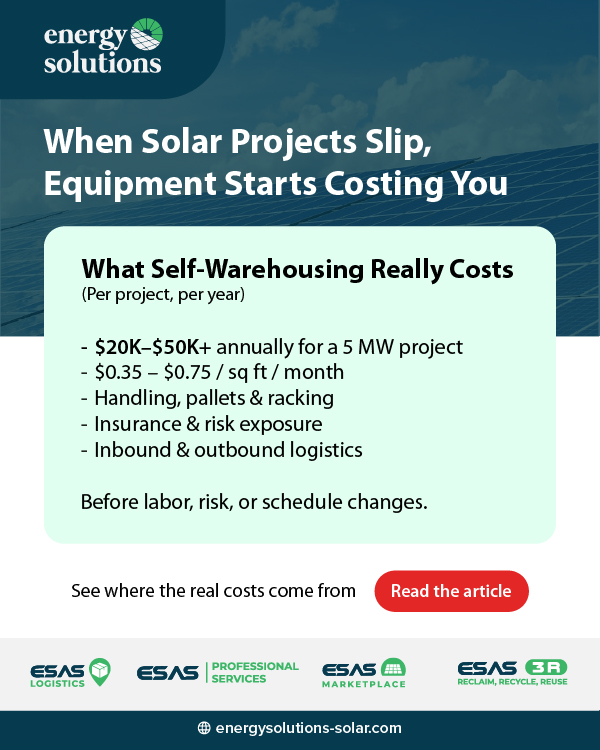
Many teams underestimate the true cost of storing solar equipment themselves. Beyond basic rent, self-warehousing typically includes:
- $20K–$50K+ annually for a typical 5 MW commercial project
- $0.35 – $0.75 per sq ft per month for industrial space
- Material handling, pallets, and racking
- Insurance and risk exposure
- Inbound and outbound logistics coordination
And that’s before accounting for:
- Labor
- Schedule changes
- Damage risk
- Warranty exposure
The hidden reality: idle equipment often costs more than storage alone.
What Happens When Storage Isn’t Planned
When warehousing and logistics aren’t part of the project strategy:
- Capital is locked up months earlier than planned
- Logistics become reactive and fragmented
- Risk of damage, mis-staging, or loss increases
- Project teams spend time managing inventory instead of advancing development
In many cases, the cash tied up in early procurement creates more pressure than the storage bill itself.
The Real Impact on Project Execution
Unplanned storage doesn’t just affect budgets it affects momentum.
Developers end up coordinating multiple warehouses, tracking equipment manually, and adjusting delivery schedules on the fly. Instead of focusing on permitting, financing, or construction readiness, teams are pulled into operational firefighting.
That distraction compounds delays and delays compound cost.
How ESAS Helps Developers Stay Flexible
ESAS removes warehousing and logistics from your critical path, so schedule changes don’t derail the entire project.
Solar-Specific Warehousing & Logistics
- Secured, indoor storage designed for solar equipment
- Serialized inventory tracking
- Flexible, phase-based release schedules
- Job-site-ready deliveries
This approach allows developers to procure equipment early without losing control of cash flow or timelines.
ESAS Provides More Than Storage
When projects stall or internal teams are stretched, ESAS Professional Services can also support with:
- Commercial design & engineering
- Permitting and AHJ submittals
- Additional technical resources when bandwidth is limited
The goal isn’t to replace internal teams — it’s to prevent small delays from turning into larger execution problems.
Our Goal Is Simple
Keep your cash moving.
Keep your schedule flexible.
Keep your team focused on execution — not storage problems.
Worth a Short Conversation
If you currently have equipment sitting in storage or are planning early procurement on an upcoming commercial solar project a brief discussion can help:
- Benchmark your true storage and cash costs
- Identify risk before it shows up on your schedule
- Determine whether logistics and design support can simplify execution