How to Choose the Best Industrial Solar Panels for Your Business Needs?
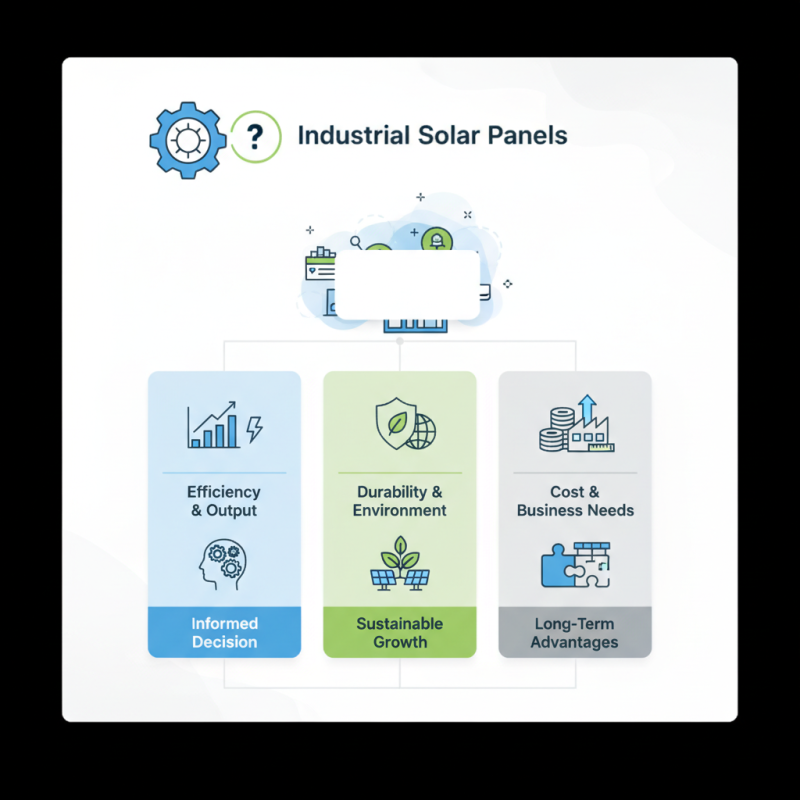
Choosing the best industrial solar panels for your business can be daunting. With so many options available, making an informed decision is essential. Industry expert Sarah Thompson states, “Investing in industrial solar panels is not just a trend; it's a necessity for sustainable growth.” Her insights remind us that the right panels can drive both efficiency and sustainability.
In today's market, industrial solar panels offer various features. It’s important to evaluate their efficiency, durability, and cost-effectiveness. A panel’s output can significantly impact energy savings. Companies often overlook the environmental benefits, which can enhance community relations.
However, the choice can be challenging. Not every solar panel suits every business type. Businesses must assess their energy needs, roof space, and budget. An informed decision can lead to long-term advantages. In the end, choosing the right industrial solar panels requires careful consideration and reflection on your specific business needs.
Identifying Your Business's Energy Needs for Solar Solutions
Understanding your business's energy needs is crucial when considering solar solutions. Start by evaluating your current energy consumption. Look at recent utility bills to understand usage patterns. Is your business operating primarily during the day? This information will influence the type of solar panels you choose.
Next, consider future growth. Will your energy needs increase in the next few years? Assessing potential expansion can help in selecting a solar system that scales with your business. Remember, not all solar panels are created equal. Some are designed for high efficiency, while others may be more cost-effective. Balancing efficiency with budget is essential.
You should also think about your geographical location. Different areas receive varying levels of sunlight, which affects solar panel effectiveness. Take time to research the average solar energy production in your region. This might lead to adjustments in your initial expectations. Reflecting on these factors can lead to better decisions for your solar investment.
Understanding Different Types of Industrial Solar Panels Available
When selecting industrial solar panels, understanding the types available is crucial. There are three main categories: monocrystalline, polycrystalline, and thin-film panels.
Monocrystalline panels are known for their high efficiency rates, often reaching up to 22%. This makes them suitable for businesses with limited roof space. However, they tend to be on the pricier side.
Polycrystalline panels, on the other hand, are more affordable but slightly less efficient, averaging around 15-17%. These panels are a viable option for larger installations where space is not a constraint.
Thin-film panels are the least efficient, typically yielding around 10-12%. Yet, they are lightweight and flexible, making them ideal for unconventional surfaces.
Tip: Evaluate your roof’s orientation and shading conditions. This will help in deciding which type of panel performs best in your specific location.
Moreover, businesses must also consider efficiency degradation over time. Most panels lose about 0.5-1% efficiency annually. This degradation could impact long-term energy savings. Regular maintenance checks can help mitigate these issues.
Tip: Future-proof your choice by researching warranties. A longer warranty can indicate better quality and performance longevity. Always be aware of your specific energy needs before making a decision.
Evaluating Panel Efficiency and Performance Metrics
When selecting solar panels for your business, efficiency and performance are key. Efficiency indicates how much sunlight is converted into usable energy. A panel that boasts high efficiency often means better energy output. For industrial purposes, look for panels with at least 15% to 20% efficiency. This range typically strikes a balance between cost and output.
Performance metrics also matter. Pay attention to temperature coefficient ratings. These ratings indicate how well panels perform in varying temperatures. A lower coefficient is preferable because it means better performance in high heat. It's essential to consider your local climate. If you're in a hotter area, this factor could significantly influence your energy production.
Reflecting on the installation process is also vital. Poor installation can compromise performance. Take time to assess installers' experience. Consider asking for references or reviewing past projects. Identifying the right panels for your specific needs requires careful analysis, but overlooking these details can lead to missed opportunities for energy savings and sustainability.
How to Choose the Best Industrial Solar Panels for Your Business Needs?
| Panel Type |
Efficiency (%) |
Power Output (W) |
Temperature Coefficient (°C) |
Warranty (Years) |
| Monocrystalline |
20.5 |
300 |
-0.37 |
25 |
| Polycrystalline |
18.6 |
270 |
-0.28 |
25 |
| Bifacial |
22.3 |
350 |
-0.34 |
30 |
| Thin-Film |
11.5 |
120 |
-0.20 |
10 |
Analyzing Cost Factors and Return on Investment
Analyzing the cost factors and return on investment (ROI) of industrial solar panels is crucial for businesses. According to industry reports, the average cost of solar installation ranges from $2.50 to $3.50 per watt. As technology advances, prices have decreased by about 30% since 2010. However, the initial investment can still be significant. While the installation may seem daunting, many businesses recoup their costs within 5 to 7 years through savings on energy bills.
Consider local incentives and tax credits that can offset costs significantly. Some areas offer rebates that can reduce the price up to 30%. This is an essential factor when calculating ROI. Don't overlook maintenance costs; factor them into your budget. Regular maintenance can increase efficiency and lifespan, which positively impacts ROI.
Tips: Always evaluate energy consumption patterns before deciding. Understanding peak usage can optimize your solar panel system's output. Also, assess future growth. If your business plans to expand, ensure your solar system can accommodate increased energy needs. Getting it right from the start is vital, as modifications later can be costly and complicated.